
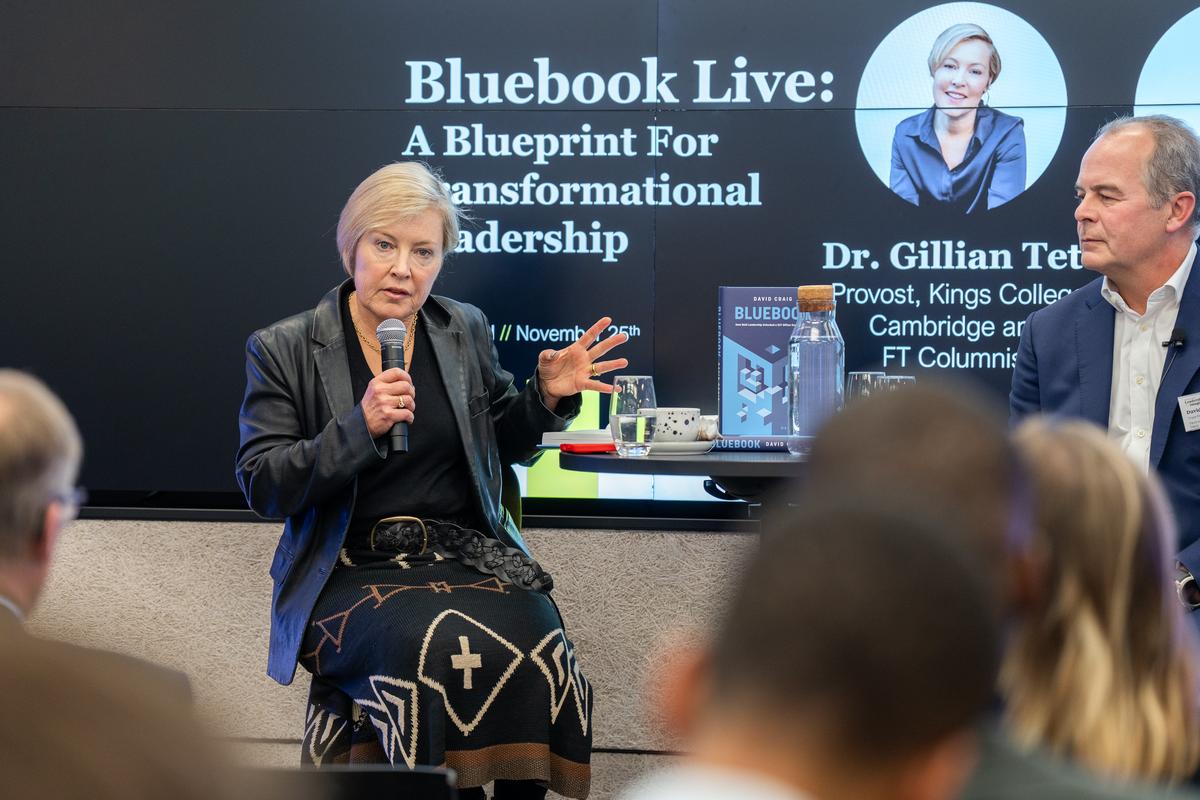
Bluebook Live: A Blueprint for Transformational Leadership
Hosted by Oliver Wyman, Leadership Re-imagined
28 Nov 2025
It was great to see many people at this week’s event with Gillian Tett on leadership and transformation. This is the sumamry by John Romeo, CEO Oliver Wyman Forum
Having the right structure and ownership is critical for a successful business. That may sound obvious, but David said the Refinitiv story was more about the decade of hard work trying to turn around the data operation than the actual transformation that took place after it was sold to Blackstone and then LSEG. It took the deep pockets and patience of the private equity firm to carry out the technological and organizational overhaul of the business. The lesson: “Make sure your capital and investment base understands what you’re trying to do and has the risk appetite to pull it off,” David said.
Complexity is a disease that plagues most large organizations. Like an infection, it spreads naturally unless management wages a determined fight against it. David recounted how the data business he took over in 2012 had numerous management layers and far more operating systems and products than it needed. He had his management team spend a week answering calls at a customer service center to experience the inefficiency first-hand. Still, he said, “It took us three years to get from three Salesforce systems to one.” A crisis also can help drive change. David explained how a sharp share price drop at one point created an urgency that enabled his team to slash its portfolio of some 800 products in half.
Business transformation depends more on people and culture than technology. Getting people to buy into the vision of creating a financial data powerhouse, empowering staff to take quick decisions, and given them a stake in the upside were critical in changing the culture at Refinitiv, David said. He abandoned the firm’s five-level performance evaluation structure, under which most employees received a middling rating and an average bonus, and replaced it with a four-level system under which people were assessed as either above or below average. It was remarkable how much change that made,” he said. “The irony of being a large data company is that the people are the most important thing.”
The Refinitiv story offers lessons for UK companies and policymakers. The country needs to break its reputation of being great at innovation but poor at commercialization. Greater tax incentives for investment in scaling up promising startups would help. Changing mindsets is even more important. David talked of the need to “break the barrier of incumbency” whereby many British business leaders know they need to adapt to rapid changes in markets and technology but don’t know how to do it. For UK data companies that can’t compete on scale with American rivals, that probably means taking a very specialized path. Refinitiv made a strategic decision to focus on providing the best data pipes under trading floors rather than trying to compete head on with its big American rival, David said, adding, “Compete by being different, not by being incrementally better.”
Thank you to David and Gillian for an inspiring and practical discussion.
Ahead of the event, we also sat down with David to explore the Refinitiv journey in more detail. Discover the inside story behind one of finance’s great transformations here.